
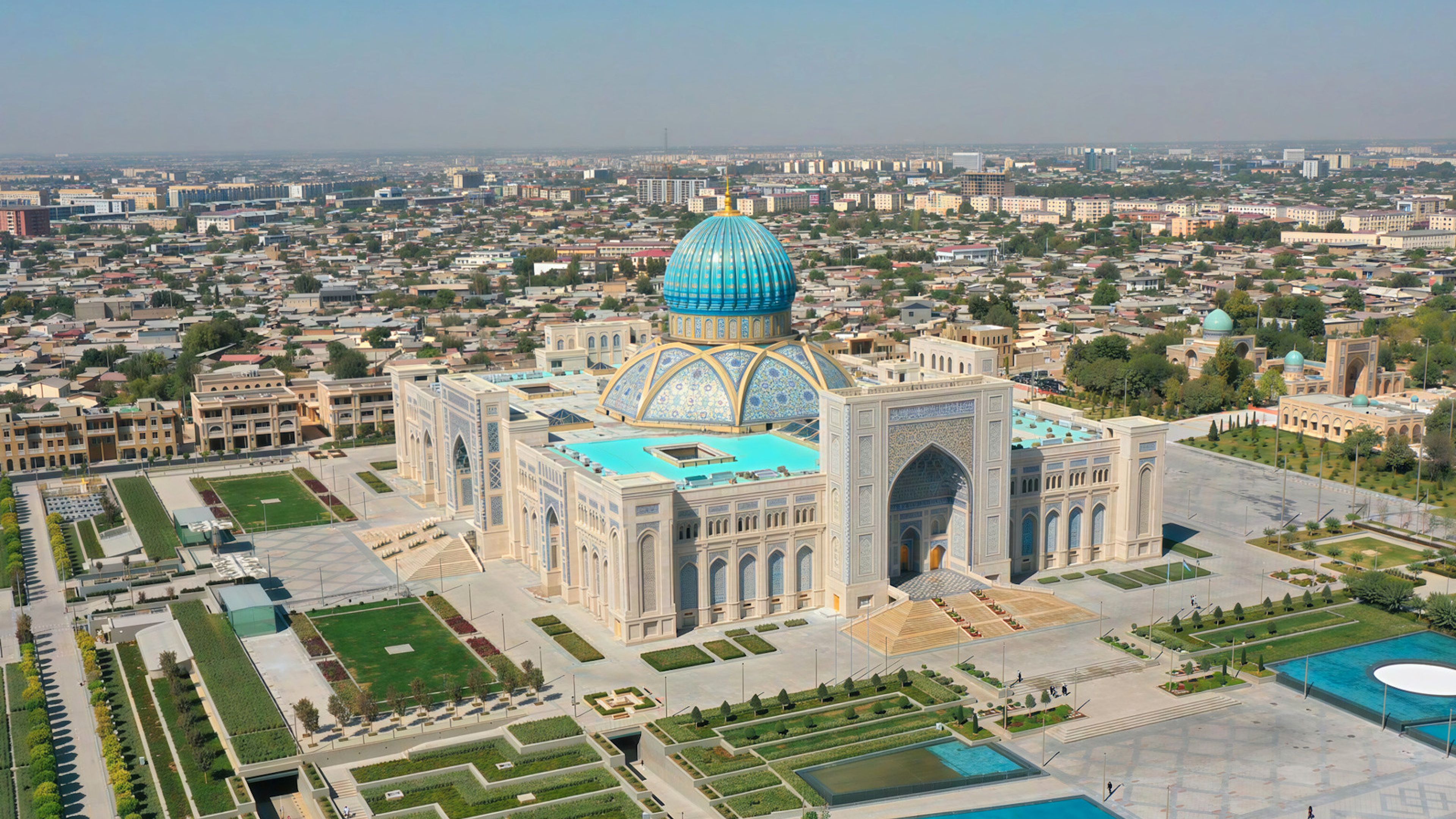
Center of Islamic Civilization
Discover the monumental Center of Islamic Civilization in Tashkent: experience millennia of cultural history, the famous Uthman Quran, interactive exhibitions, and impressive architecture right next to the Hazrati Imam Complex.
About this place
Center of Islamic Civilization: A Monumental Beacon Between Grand Heritage and Modern Future
In the heart of the vibrant capital city of Tashkent, right next to the venerable Hazrati Imam Complex, rises an architectural and scholarly masterpiece that is sustainably redefining the cultural landscape of Central Asia: the Center of Islamic Civilization. Stepping inside this monumental ensemble offers far more than a traditional museum visit. It is an impressive journey through five millennia of Central Asian intellectual history, a hub for intercultural dialogue, and a radiant tribute to the great scholars, thinkers, and artists who, from Uzbekistan, profoundly shaped world science for centuries. Serving as a bridge between the Golden Age of Islamic enlightenment and the country's modern, cosmopolitan awakening, the center unites age-old spirituality with forward-looking museum technology.
General Information: An Intellectual Space for Knowledge, Education, and Encounter
Located in Tashkent's Olmazor district (47 Karasaray Street), the Center of Islamic Civilization deliberately conceives itself not as a purely religious institution, but as a premier center of excellence for scholarship, culture, and education. Guided by the motto "Civilization, Personality, and Discovery," it illuminates the entire cultural evolution of Central Asia—from pre-Islamic high civilizations such as ancient Sogdiana, through the First and Second Islamic Renaissances, right up to the present day.
Across an impressive total area, the three-story complex brings together under one roof:
- A state-of-the-art museum spanning roughly 15,000 square meters of exhibition space and housing nearly 3,000 priceless original artifacts from home and abroad.
- One of the largest specialized libraries in the region, preserving around 250,000 publications alongside approximately 100,000 valuable historical manuscripts and their digital copies, accessible to international researchers.
- Interactive learning laboratories, conference halls, and virtual experience worlds that bring history to life for visitors of all generations through holograms, time capsules, and digital avatars.
History: From Vision to the Rebirth of a Scholarly Legacy
The origins of the center are closely tied to the endeavor to bring the historical role of Uzbekistan as one of the world's most significant cradles of science and culture back into the global spotlight.
- The Birth of a Vision (2017): Initiated by President Shavkat Mirziyoyev in 2017—including during a widely acclaimed address before the United Nations General Assembly—the foundation was laid for creating a landmark in Tashkent that conveys the true humanistic and scientific essence of Islamic civilization.
- Groundbreaking and International Collaboration (2018–2025): In June 2018, the ceremonial groundbreaking took place on a roughly ten-hectare site directly adjacent to the historic Hazrati Imam Complex. Over the following years, an unprecedented international network took shape: scholars from more than 30 countries alongside renowned institutions such as IRCICA, ICESCO, TURKSOY, and the Oxford Centre for Islamic Studies guided its conceptualization. Simultaneously, a state commission worked closely with the World Society for the Study, Preservation and Popularization of the Cultural Legacy of Uzbekistan (WOSCU) to repatriate rare historical manuscripts and art treasures from international collections back to their homeland.
- Opening as a New Landmark (2026): Following intensive years of construction and research, the center opened its doors in spring 2026 as one of the most significant cultural and museum projects in Central Asia. With daily opening hours from 9:00 AM to 10:00 PM, it sets entirely new standards in the region's museum landscape.
Architecture and Exhibition Design: Tradition Meets Monumental Aesthetics
Even from afar, the building of the Center of Islamic Civilization commands attention. Measuring 145 meters in length and 115 meters in width, the structure blends the timeless design language of classical Central Asian architecture—particularly from the Timurid and Samanid eras—with cutting-edge engineering.
Exterior Symbolism
- The 65-Meter-High Dome: The far-visible centerpiece of the edifice is its majestic turquoise-blue dome, soaring 65 meters into the sky and evoking the grand domed monuments of Samarkand and Bukhara.
- Four Monumental Portals (Pishtaqs): Facing all four cardinal directions, towering entrance portals adorned with intricate traditional ornamentation, calligraphy, and geometric patterns open up to visitors. They symbolize openness, hospitality, and the free exchange of knowledge with every corner of the globe.
Thematic Worlds Inside
Inside unfolds a thoughtfully curated journey guiding visitors through distinct historical eras and thematic galleries:
- The Quran Hall – The Spiritual Heart: Directly beneath the 65-meter main dome lies the conceptual and spiritual focal point of the entire complex. Here, one of the oldest and most revered written monuments in the world is preserved with utmost reverence: the 7th-century Quran of Caliph Uthman (Samarkand Kufic Quran), inscribed on fine deerskin and listed in the UNESCO Memory of the World Register. Surrounded by precious Quranic manuscripts from various eras and a mesmerizing light and projection installation featuring over a million Swarovski crystals, the hall radiates an atmosphere of profound sublimity.
- The Gallery of Great Personalities: Fourteen artistically crafted arches trace the decisive turning points of Central Asian history. Via interactive touch terminals, more than a hundred influential thinkers and polymaths—including Al-Khwarizmi (the founder of algebra), Ibn Sina (Avicenna), Al-Biruni, Mirzo Ulugbek, and Imam Al-Bukhari—come to life as digital avatars to explain their groundbreaking discoveries to visitors.
- The Hall of Pre-Islamic Civilizations (Sogdiana Hall): Long before Islam shaped the region, highly developed civilizations flourished along the Silk Road. This section showcases exquisite textiles, sculptures, ceramic and metal vessels, coins, and handicrafts from ancient Sogdiana, vividly demonstrating the continuity of cultural ingenuity.
- The Square of Tolerance: Within the First Renaissance section, intricately detailed architectural models of landmark monuments—including the Samanid Mausoleum, the Magoki-Attori Mosque, the Chashma-Ayub Mausoleum, and the Rabati Malik Complex—illustrate the centuries-old tradition of religious, cultural, and intellectual tolerance that has defined coexistence in Uzbekistan across generations.
Legends, Oral Traditions, and the Mystique of Sacred Manuscripts
Deeply rooted historical traditions and legends surround both the center's location and its most prized exhibits, lending every visit an extraordinary spiritual dimension:
- The Miraculous Journey of the Uthman Quran: According to tradition, the third Caliph, Uthman ibn Affan, was holding this very copy of the Quran in his hands when he fell victim to an assassination in Medina in 656; to this day, dark stains on the parchment pages are said to bear witness to that dramatic moment in early Islamic history. Traveling via Damascus and Baghdad, the sacred volume was eventually brought to Samarkand by Amir Timur (Tamerlane) in the 14th century. In the 19th century, Russian authorities took the manuscript to Saint Petersburg before it returned to Tashkent in the 20th century, finally finding its worthy home at the heart of the center.
- The Legend of Hazrati Imam (Kaffal al-Shashi): The center stands on hallowed historical ground right beside the mausoleum of Abu Bakr Muhammad ibn Ali Ismail al-Kaffal al-Shashi (904–976), one of Tashkent's most celebrated scholars. Oral tradition holds that he was not only an eminent jurist and poet, but also a master locksmith (hence his epithet al-Kaffal—"the Locksmith"). Legend tells that he once crafted a lock so tiny and intricate that it fit inside the eye of a needle, and that his wisdom left even the mightiest rulers of his era in awe.
- The Wellspring of Knowledge on the Silk Road: Old accounts by Tashkent chroniclers recount that the scholarly circles around the historic quarters of Sebzar and Karasaray were once known as the "Gate of Wisdom." Traveling caravans stopped here not merely to replenish water and provisions, but to seek the counsel of the masters before crossing the perilous desert and mountain passes of the Silk Road. The new center symbolically carries this venerable tradition forward.
Touristic Potential: A Must-Visit for Culture Enthusiasts and Explorers
For travelers from around the world, the Center of Islamic Civilization has swiftly become one of the most compelling attractions in Uzbekistan. Its touristic appeal lies in the seamless fusion of scholarly depth, visual grandeur, and accessible, modern visitor guidance:
- The Ideal Starting Point for Any Central Asia Journey: Travelers beginning their itinerary in Tashkent gain a comprehensive overview of the country's entire history, architecture, and intellectual heritage right here. Many monuments in Samarkand, Bukhara, or Khiva reveal themselves in an entirely new light after a visit to the center.
- Experiential Learning for All Ages: Through four immersive "time capsules," multimedia projection shows, a dedicated interactive children's museum featuring "living portraits" of famous scholars, as well as multilingual audio guides and robotic guides, history becomes vivid, engaging, and effortlessly accessible.
- Harmonious Pairing with Historic Heritage: Thanks to its immediate proximity to the Hazrati Imam Complex, the Barak-Khan Madrasah, and the traditional alleys of Tashkent's Old City, a visit to this modern monumental landmark pairs effortlessly with a stroll through the historic soul of the capital.
The Center of Islamic Civilization stands as a powerful testament to the pride and forward-looking spirit with which Uzbekistan nurtures its cultural legacy. It invites visitors from all backgrounds to rediscover the shared roots of science, tolerance, and human creativity—an unforgettable experience that resonates long after the journey ends.
💡 Visitor tips
Plan at least two to three hours for your visit to the Center of Islamic Civilization and ideally start in the morning to experience the interactive exhibitions and the Quran Hall at a relaxed pace. Take advantage of the multilingual audio guides and combine your visit directly with a stroll through the neighboring Hazrati Imam Complex.
🧳 Travel Essentials
Everything for your perfect Central Asia trip
* Affiliate links – we earn a small commission at no extra cost to you.