
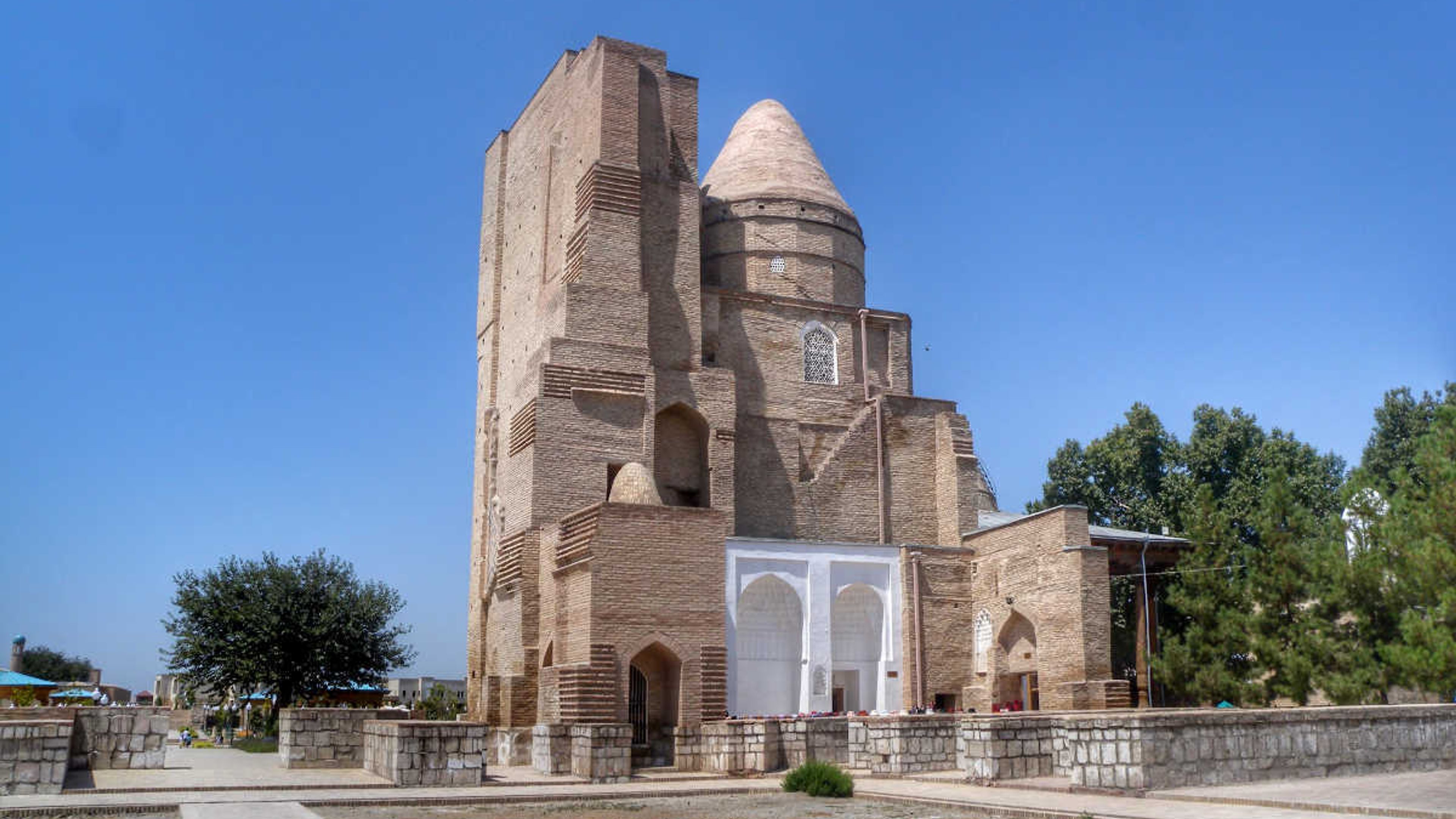
Shahrisabz - Complejo Dorus Saodat
El complejo Dorus Saodat en Shahrisabz es una majestuosa necrópolis timúrida que alberga el mausoleo de Jahangir y la intrigante cripta subterránea construida por orden de Tamerlán.
Sobre este lugar
The Dorus-Saodat complex in Shahrisabz – A monument of the Timurid dynasty
Shahrisabz, the historic birthplace of the legendary ruler Amir Temur, was not only a significant political and military center in the 14th and 15th centuries, but also a place of cultural and religious life. In addition to the monumental Ak-Saray Palace, another extraordinary structure was built here in 1380: the Dorus-Saodat complex, which is considered one of the most important mausoleum ensembles in Central Asia. Today, the Jahangir Mausoleum and the burial site of Amir Temur remain from this once magnificent memorial ensemble – a tomb in which the great conqueror was, however, never laid to rest.
A tragic occasion – The creation of the complex
The construction of the Dorus-Saodat complex stems from a deeply moving tragedy. In 1376, Temur's eldest son, Jahangir, died unexpectedly at the age of only 22. The young prince was not only Temur's firstborn son but also his designated heir to the throne. His sudden death shook the entire region and plunged the ruler himself into deep mourning. Contemporary chroniclers described Jahangir as “a handsome prince and a brave soldier who blossomed like a rose on earth.”
The body of the prince, who died in Samarkand, was transported to the home of his ancestors, Shahrisabz, and buried in an old family cemetery. Even at this time, Amir Temur harbored the idea of building a dynastic burial site here for himself and his descendants. After his successful campaign against Khorezm, he began construction of the Dorus-Saodat complex four years later, in 1380.
The architecture of the Dorus-Saodat complex
The complex was conceived as a monumental memorial that included both a burial site and a spiritual educational institution. A mausoleum was built over Jahangir's grave, which was attached to a madrasa. The madrasa served as the philosophical and religious center of the ensemble. Some historians interpret the name Dorus-Saodat as “Lessons in Power,” an Arabic interpretation of the term.
The Mausoleum of Jahangir
The magnificent mausoleum for Jahangir was the architectural centerpiece of the complex. Contemporary reports, especially those of the Spanish envoy Ruy González de Clavijo, describe the structure as decorated with gold, azure, and ornate tiles. The interiors were designed with the finest faience and intricately carved marble, while the walls were adorned with calligraphy and ornamental patterns.
The lost madrasa and economic security
To the east of the mausoleum was the Ziyaratkhona, a prayer hall. Archaeological excavations have also found traces of a monumental portal niche of the madrasa, which had an impressive span of over 20 meters between the abutments. The former main entrance led through a corridor into the courtyard of the madrasa, where hujras – small living cells for scholars – were located.
Unlike most madrasas, which served as colleges for Islamic sciences, the Dorus-Saodat Madrasa was primarily a memorial building. Its economic maintenance was secured by extensive waqf endowments. These consisted of lands, orchards, and agricultural estates, the proceeds of which were used for the maintenance of the burial sites and the support of the staff. Furthermore, it was a royal decree of Temur that twenty cooked sheep be brought to the madrasa daily and distributed to the needy.
Unfortunately, the madrasa fell victim to destruction by Abdullah Khan in the 17th century, so that today only a few foundation walls and remains of the once magnificent portal have survived.
The second tragedy – The death of Umar Sheikh
In 1394, Amir Temur suffered another hard blow of fate: his second son, Umar Sheikh, fell during the siege of a Kurdish fortress in Iran. He, too, was transported to Shahrisabz and buried in the Dorus-Saodat complex. The double tragedy of his deceased sons finally turned the memorial complex into a dynastic sanctuary.
The unfinished mausoleum of Amir Temur
Although Amir Temur also wanted to be buried in the Dorus-Saodat complex, his mausoleum was never completed. In 1404, he personally inspected the structure and was dissatisfied, as the entrance appeared too low to him. He ordered an adjustment to the architecture, but his sudden death in 1405 left the work unfinished.
Instead of in Shahrisabz, the great conqueror was finally buried in the Gur-Emir necropolis in Samarkand. Nevertheless, thanks to historical documents and archaeological research, his original tomb within the Dorus-Saodat complex could be identified.
The mystical crypt – A symbol of the ephemeral
Particularly impressive is the underground crypt, which is considered one of the few surviving structures of the planned mausoleum of Amir Temur. A steep staircase leads into a small burial chamber of barely 40 square meters, built from light gray marble limestone blocks. The walls, the dome, and the floor are decorated with artistic inscriptions and Quranic verses in Thuluth script. The words can be read:
In the center of the crypt is a massive marble sarcophagus, which is covered with a heavy, 11-centimeter-thick marble slab. Five iron rings at the corners and in the center indicate that the tomb might have been intended to be opened or rearranged later.
The Dorus-Saodat complex today – A place of remembrance
Despite the partial destruction by time, the Dorus-Saodat complex remains a fascinating place of history. The few surviving structures bear witness to the former splendor of Timurid architecture and make the site a significant cultural monument of Uzbekistan.
The complex is now one of the most important sights of Shahrisabz and attracts visitors from all over the world who want to marvel at the imposing remains and immerse themselves in the deeply moving history of Temur's family.
The Dorus-Saodat complex is far more than just a burial site – it is a symbol of the greatness and the tragedies of the Timurid dynasty. Its monumental ruins tell the story of one of the most significant ruling families of Central Asia and remind us of the legacy of Amir Temur, whose influence is still palpable today.
💡 Consejos de visita
Visite el monumento por la mañana para disfrutar de la tranquilidad y tomar las mejores fotos con luz natural. Dedique entre 1 y 1.5 horas para recorrer el recinto y descender a la cripta histórica. Recuerde vestir con ropa modesta al tratarse de un sitio sagrado.
🧳 Esenciales de viaje
Todo para tu viaje a Asia Central
* Enlaces de afiliado – pequeña comisión sin coste extra.