
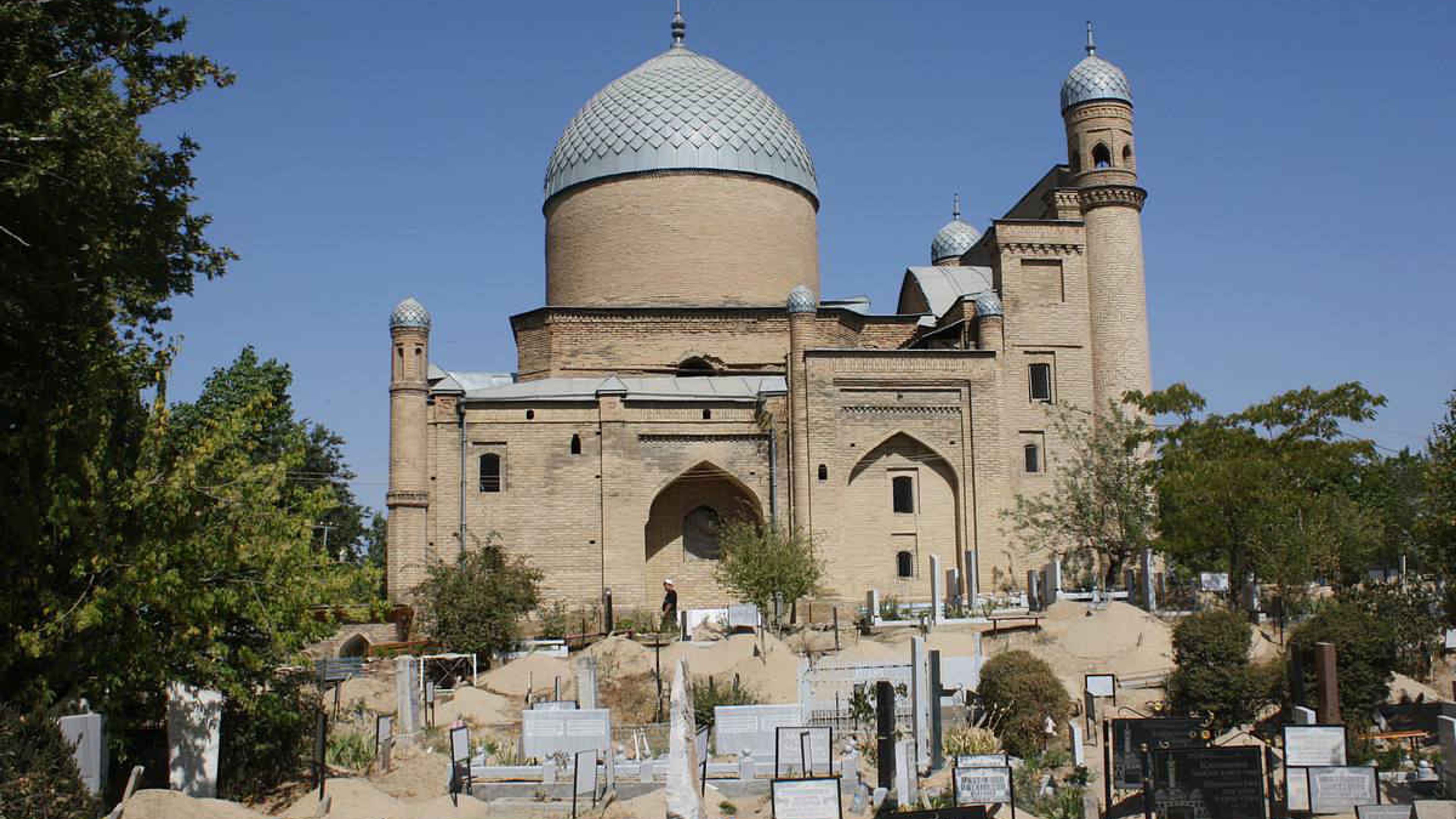
Tashkent - Mausoleo de Zayniddin Bobo
El Mausoleo Zayniddin Bobo en Taskent es una joya sagrada del sufismo, famosa por su atmósfera pacífica y su milenaria cripta de meditación chillakhona.
Sobre este lugar
This mausoleum in Tashkent is dedicated to Sheikh Zayniddin-Bobo (Zaynid-Din-bobo) - the son of Sheikh Shahobiddin Abu Khavs, the head of the Sufis in Baghdad, the "Sheikh of Sheikhs" - the founder of the school to which later Shamsiddin Kulol, the spiritual advisor of Emir Taraghai - Temur's father and Temur himself, belonged.
Sheikh Zayniddin was born in 1214. The legend, written down from the words of the mausoleum's guardian, states that Sheikh Shahobiddin sent Zayniddin Bobo from Baghdad to Tashkent 600 years ago, where he lived in a chillakhona. After his death, his followers erected a small mausoleum (chortak) over his grave.
Later, Amir Temur rebuilt the chortak, and there were 3-4 further repairs. At the site of the existing building, there was an old chortak ruin from the end of the XIV century, the remains of which lie beneath the current structure. The lower walls date back to the XVI century. The upper part of the building from the squinches upwards, as well as the portal, were extensively rebuilt at the end of the XIX century.
The mausoleum is a multi-chambered, longitudinally axial, four-portal domed structure with a highly developed peshtak, which highlights the southeastern facade as the main facade.
A large square hall, enclosed within the rectangular prism of the main building, is cruciform in plan due to the four deep niches in the centers of the walls. The hall is blocked by a double dome with a high inner cylindrical drum.
The fine details are decorated with patterns of craftsmanship: a double-leaf carved wooden door covered with vegetative ornaments. Above it is a window with a wooden lattice (panjara): a wide frame with a fine grid, and in the central panel - a round star girikh, built on an equilateral triangle.
The lattice made of ganch (panjara), a variety of designs, adorns large and small window openings of secondary facades.
The dimensions of the building: the total plan is 16 x 18 m, the height to the peak of the dome - 20.7 m, the height of the portal - 14.5 m.
The inscriptions of the mausoleum date from a later period and refer to its repairs. Engraved on the wooden door frame is: "The master Mir Sharab Abdu Mumin Oghli", the date is cut off.
In the inscription above the southwestern corner of the portal, the date of the major repairs is given - 1339 AH (1920-1921). This repair and the subsequent one in 1927 disfigured the appearance of the monument. The peshtak was once covered with glazed tiles. Fragments of majolica tiles were found during excavations in the construction debris.
The oldest part of the mausoleum is the chillakhona, which was built from bricks from the XI-XII centuries. The fact that the bricks were used in the XI-XII centuries points to its use at the beginning of the XIII century.
The lower parts of the chillakhona have survived to our time, while the chortak over the sheikh's grave apparently collapsed and was likely rebuilt later on Temur's orders, as the legend states.
The chillakhona is the room for the forty-day fast. It was "embedded" into the ground in such a way that only the dome with the light lantern remained on the surface.
The chillakhona consists of two horizontally arranged rooms: the upper one is octagonal with a mihrab niche on one of its southwestern sides, while the lower one is also octagonal, but with much smaller dimensions.
The lower room can be reached via a special staircase and a corridor arranged at a right angle.
💡 Consejos de visita
La mejor hora para visitarlo es a primera hora de la mañana para evitar las horas de calor. Se recomienda llevar ropa modesta que cubra hombros y rodillas al tratarse de un lugar de devoción activo. Dedique entre 45 minutos y una hora para recorrer el complejo con calma.
🧳 Esenciales de viaje
Todo para tu viaje a Asia Central
* Enlaces de afiliado – pequeña comisión sin coste extra.