Discover Samarkand, the legendary Silk Road jewel. Explore the iconic Registan, ancient madrasas, and vibrant Chorsu Bazaar with Turkestan Travel's expert guides.
There are city names that are far more than mere geographic coordinates on a map. They are names that sound like a magic spell, evoking a deep yearning and inevitably conjuring up images of dusty caravans, heavily laden camels, exotic spices, and the almost immeasurable wealth of the Orient. Samarkand is undoubtedly the most resonant of these names.
With a history spanning over 2,750 years, Samarkand is as old as Rome, Athens, or Babylon. The city was conquered by Alexander the Great, reduced to ashes by Genghis Khan, and finally rebuilt in the 14th century into one of the most magnificent metropolises of the world's great empires by the fearsome yet culturally visionary ruler Amir Timur (Tamerlane). Even Alexander the Great is said to have remarked upon his arrival: "Everything I have heard about Marakanda is true, except that it is even more beautiful than I could ever have imagined."
Modern travelers arriving in Samarkand today will quickly discover that this quote has survived the millennia unscathed. Uzbekistan's second-largest city, rightfully declared a World Heritage Site by UNESCO as a "Crossroads of Cultures," is a living masterpiece of Islamic architecture and an absolute must for anyone who wants to feel the true magic of Central Asia.
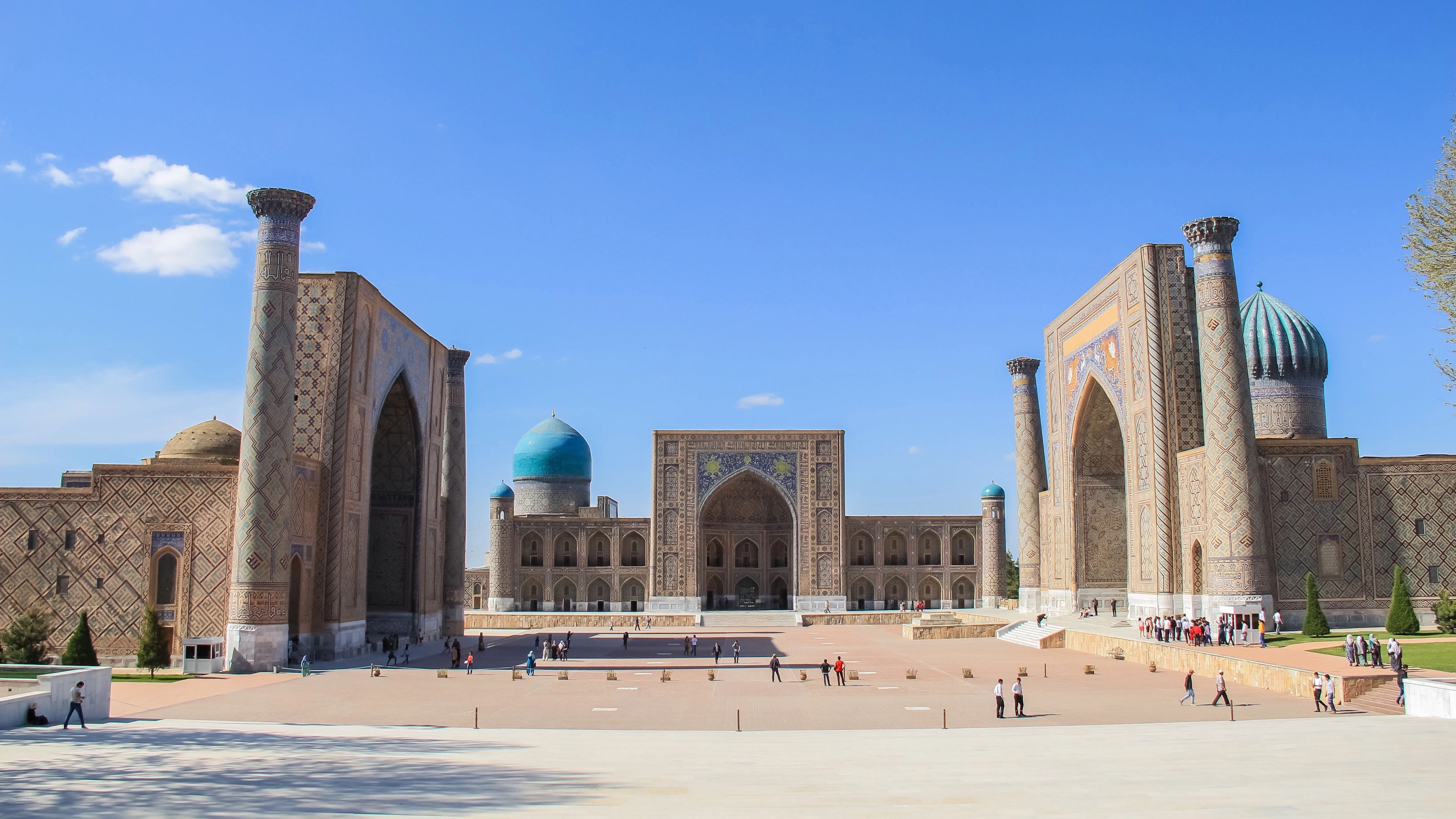
Every journey to Samarkand inevitably leads to it, and no photograph, no matter how spectacular, can prepare you for the moment you first see it with your own eyes: the Registan. It is the undisputed heart of the city and one of the most awe-inspiring public squares in the entire world. Translated, Registan means "sandy place," but what awaits you here is an architectural marvel of monumental grandeur.
Three massive madrasas (Islamic educational institutions) frame the square on three sides, their facades entirely covered with millions of glazed tiles in lapis lazuli, turquoise, and ochre. The oldest, the Ulugbek Madrasa on the left, was built in the 15th century by the eponymous ruler and brilliant astronomer. Its stellar motifs bear witness to Ulugbek's love of science. Opposite stands the 17th-century Sher-Dor Madrasa. It is famous for the almost psychedelic-looking beasts of prey (a mix of tiger and lion) emblazoned above its portal, hunting on the backs of gazelles and carrying suns with human faces on their backs—a deliberate and fascinating break with the Islamic prohibition of depicting living beings. Finally, in the center rises the Tilya-Kori Madrasa. Entering its interior leaves visitors literally speechless: the ceiling of the mosque is so richly and elaborately adorned with pure gold leaf (Tilya-Kori means "covered in gold") that it sends the beholder into a visual frenzy.
A tip for travelers: Make sure to visit the Registan at two different times of the day. Once in the soft, golden light of the early morning, when you will have the square almost entirely to yourself, and once in the late evening, when the buildings are artfully illuminated, and swallow-like birds circle in large flocks around the glowing domes.
Not far from the Registan, a striking, deeply azure-ribbed dome rises into the Uzbek sky. Beneath it lies the Gur-e-Amir Mausoleum, the tomb of Amir Timur. The man whose empire stretched from India to Turkey originally had this masterpiece built for his beloved grandson, but ultimately found his own final resting place here.
The interior of the mausoleum is a symphony of marble, onyx, and filigree gold embellishments. In the center of the room, a single, massive block of dark green jade marks the conqueror's grave. One of Central Asia's most famous legends surrounds this site: the "Curse of Timur." When Soviet archaeologists opened the sarcophagus on June 20, 1941, despite urgent warnings from local scholars, they found an inscription inside: "Whosoever opens my tomb shall unleash an invader more terrible than I." Just two days later, the troops of Hitler's Germany invaded the Soviet Union. Whether myth or coincidence—the aura surrounding this place remains tangibly palpable to this day.
If the Registan is the heart of Samarkand, then Shah-i-Zinda is its soul. This necropolis (city of the dead) is perhaps the most visually overwhelming place in all of Uzbekistan and every photographer's dream come true.
Shah-i-Zinda, which translates to "The Living King," is a narrow, ascending alleyway lined with an uninterrupted row of breathtaking mausoleums. Female members of Timur's family and his generals are buried here. The complex takes its name from Qusam ibn Abbas, a cousin of the Prophet Muhammad, who preached Islam here in the 7th century and, according to legend, still lives in the subterranean vaults today. Nowhere else in the world will you find such a density and perfection of majolica and terracotta tiles. The colors vary from delicate sky blue to bold turquoise and the deepest cobalt blue. When the sunlight cascades into the narrow alley and makes the tiles glow, you inevitably feel transported to another dimension.
Timur did not think in ordinary scales. Following his successful campaign in India, he set out to build the largest mosque in the Islamic world—dedicated to his favorite wife, Bibi Khanym. The result was a structure of such colossal proportions that it pushed the architectural techniques of the time beyond their limits. Shortly after its completion, stones began falling from the massive main dome, as the building groaned under its own weight and the ambitious pace of its builders. Today, the Bibi-Khanym Mosque has been carefully restored and still serves as a testament to a ruler who literally wanted to reach for the stars.
Right next to the monumental walls of the mosque, you can dive into the vibrant, loud, and colorful everyday life of Uzbekistan at the Siyob Bazaar. It is Samarkand's largest market and a true feast for the senses. Sun-ripened pomegranates, dried mulberries, steaming spices, almonds, and giant sacks full of raisins are piled high here. Above all, this bazaar is the perfect place to taste the famous Samarkand bread (Non). This heavy, dense, disc-shaped flatbread is decorated with a traditional stamp and is legendary throughout the country. Uzbeks believe that Samarkand's unique climate and water make the bread's flavor unmistakable. Eating a piece of fresh, still-warm Samarkand bread plain, while watching the hustle and bustle of the bazaar, is a culinary experience you won't forget.
Samarkand was not only a city of conquerors but also of scholars. The Ulugbek Observatory on the outskirts of the city is proof of this. In the 1420s, Ulugbek, Timur's grandson, had a three-story observatory built here featuring a gigantic subterranean sextant. His calculations of the stellar year were so incredibly precise that they were only marginally corrected centuries later by modern telescopes.
Another fascinating piece of history can be found in the nearby village of Konigil. Here, at the Meros Paper Mill, an ancient craft tradition is kept alive: the production of Samarkand silk paper. The technique was brought to the city by Chinese prisoners of war in the 8th century. The paper is hand-crafted from the bark of the mulberry tree in a laborious process. It is extremely durable, water-repellent, and has a lifespan of several centuries. A visit to the idyllic watermill, where the bark is still pounded according to old methods, offers a wonderful, tranquil contrast to the monumental buildings of the city center.
Today, Samarkand is more accessible than ever. The city is exceptionally safe, the streets are well-maintained, and Uzbek hospitality is legendary. Thanks to the ultra-modern Afrosiyob high-speed train, you can reach Samarkand from the capital, Tashkent, comfortably and conveniently in just over two hours.
Samarkand is not a museum where time has stood still. It is a living, breathing city where past and present magically weave together. When you stroll through the alleys in the evening, breathing in the scent of freshly roasted shashlik and cumin, and watching the illuminated blue domes stand out against the starry sky, you will feel it yourself: Samarkand is not just a travel destination. It is an encounter with world history that enriches the mind and shapes the soul forever. Embrace this adventure—the fairytale of the Silk Road is waiting for you.
The best time to visit Samarkand is during spring (April to May) and autumn (September to November). Temperatures are comfortable for walking around ancient monuments like the Registan. Summer can be quite hot, while winter offers quiet, snow-dusted sights. Plan your Silk Road adventure during these ideal seasons for the best experience.
Samarkand features a continental climate with warm, sunny summers and crisp winters. Spring brings blooming flora and moderate temperatures ideal for sightseeing. Autumn offers pleasant dry weather, perfect for exploring blue-tiled architecture. High summer temperatures are offset by low humidity.
Samarkand International Airport welcomes flights from key international hubs. You can also take the high-speed Afrosiyob train from Tashkent, reaching the city in just over two hours. Turkestan Travel provides seamless private airport transfers and guided transport. We make your arrival smooth and completely stress-free.