
Kyrgyzstan, Uzbekistan and Turkmenistan Tour
Kyrgyzstan, Uzbekistan, and Turkmenistan Tour: An Expedition through History, Culture, and Nature
Over thousands of years, the peoples of Central Asia have shaped a unique, multifaceted and exceptionally rich history. In terms of its cultural depth and historical significance, it is in no way inferior to the great civilisations of antiquity such as India, Persia, Egypt or the Roman Empire. For a long time, this region was perceived in Western history as merely a transit area. In fact, however, Central Asia itself was a centre of advanced civilisations, innovation and intellectual exchange. Archaeological finds prove continuous settlement for more than 3,000 years, and numerous buildings and urban complexes are over 2,000 years old and still tell of an impressive past.
Day by Day Itinerary
- 1
Arrival in Bishkek and transfer to the hotel. Following breakfast, we visit notable sites including Victory Square, Oak Park, Ala-Too Square, the State Historical Museum, the National Philharmonic, and other landmarks. We also explore the oriental bazaar, offering insight into Kyrgyz culture and daily life. Dinner at a local restaurant. Overnight stay in a 3-star hotel.
- 2
After breakfast, we drive to Chok-Tal. En route, we visit the Burana Tower (11th century) and the open-air stone warrior museum. Upon arrival in Chok-Tal, time at leisure by Lake Issyk-Kul. Dinner at a local restaurant. Overnight stay in a 3-star hotel.
- 3
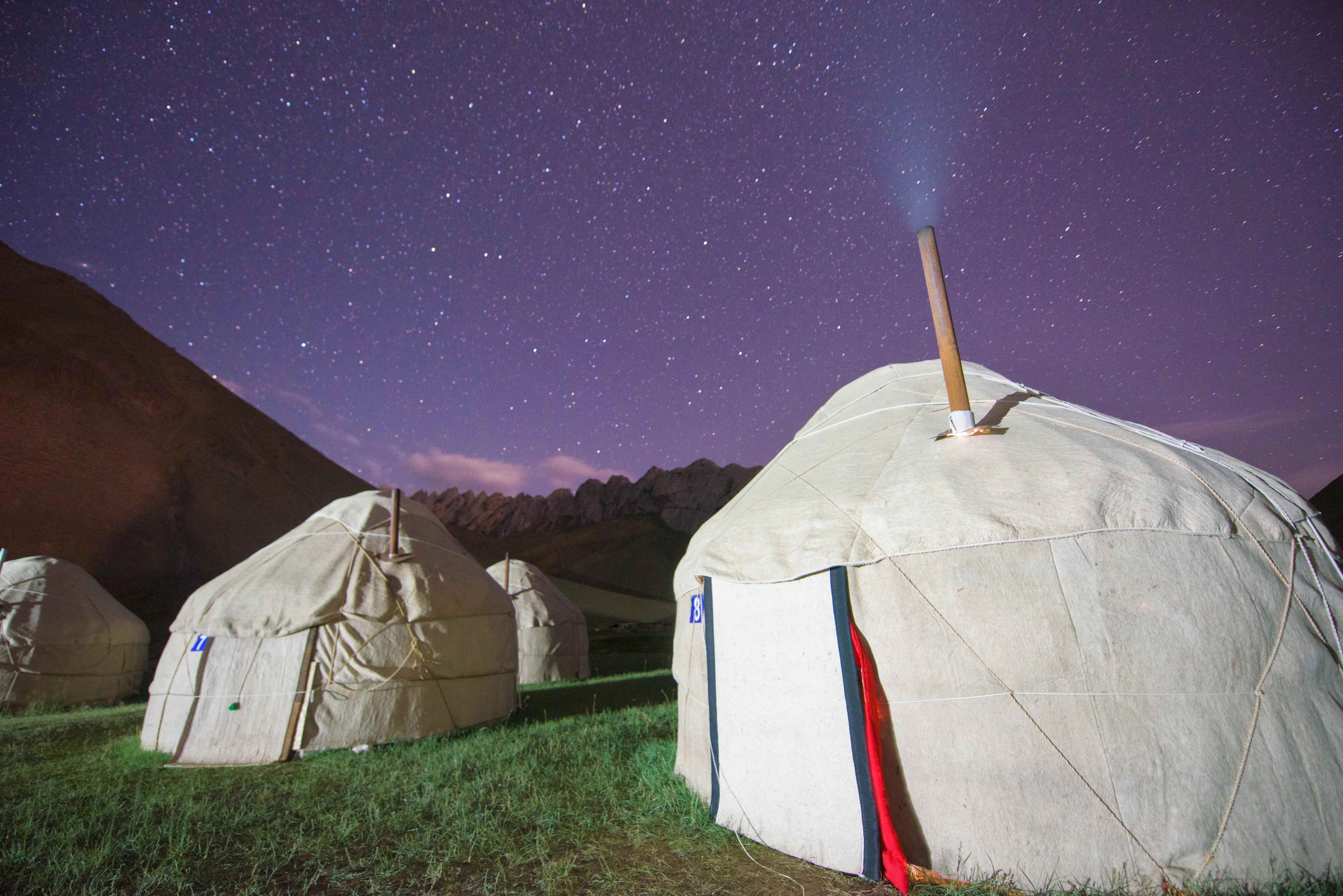
Following breakfast, we continue our journey to Kochkor (110 km). We take a walking tour of the village, visiting a family-run wool-weaving enterprise. In the afternoon, we drive via the 3,448-meter-high mountain pass to Lake Song Köl (105 km). Upon arrival, we embark on a two-hour hike along the lakeshore. Dinner and overnight stay in a yurt, providing an authentic introduction to nomadic life.
- 4
After breakfast in the yurt, we drive back to Bishkek (305 km), stopping for lunch along the way. From Bishkek, you take a flight to Osh. Upon arrival in Osh, check-in at the hotel followed by dinner at a local restaurant. Overnight stay in a 3-star hotel.
- 5
Breakfast at the hotel at a suitable time, followed by a tour of Osh. We visit the oriental bazaar in Osh and Suleiman-Too (Solomon’s Mountain). Revered as a sacred site in Kyrgyzstan, Suleiman-Too is a UNESCO World Heritage site. Its caves and rock faces, particularly on the eastern slope, feature over 100 petroglyphs depicting humans, animals, dragons, the sun, moon, and geometric shapes dating back to the earliest settlements of the Middle Bronze Age. King Solomon, known to Christians from the Bible and revered as a prophet in the Quran, is said to be buried at the foot of the mountain. Lunch at a local restaurant in Osh. In the afternoon, we drive to the Osh – Andijan border crossing (Andijon). After completing border formalities, we change transport and take a sightseeing tour of Andijan. We then proceed to Fergana for a brief tour before continuing to Margilan. Upon arrival, check-in at the hotel. Dinner at a local teahouse. Overnight stay in a 2-star hotel.
- 6
Following breakfast, we tour Margilan, one of Uzbekistan's oldest industrial cities and a historically vital hub along the Silk Road. In Margilan, we visit the traditional “Yodgorlik” silk factory, which preserves centuries-old manufacturing techniques, and explore the Margilan Bazaar. Lunch is served at a traditional teahouse in Margilan. Afterwards, we drive to Rishton. Rishton produces nearly 90% of all ceramics in Uzbekistan, a tradition passed down from father to son for some 800 years. We visit a local artisan ceramic family to observe traditional pottery methods. We then continue to Kokand. With a population of nearly 200,000, Kokand is a historic Silk Road crossroads and former capital of the Khanate of Kokand, which experienced its golden age in the 19th century. Lunch at a local restaurant. In Kokand, we visit the Palace of Khudayar Khan, built between 1833 and 1873, featuring an ornate, brilliantly colored facade spanning some seventy meters adorned with traditional folk art and ceramic motifs. We also visit the Juma Mosque (built 1809–1812), the Amin-Beg Madrasah, the Dakhma-i-Schochon necropolis, the Modari Khan Mausoleum, and the Hamza Museum. In the afternoon, we take the train back to Tashkent. Dinner at a local restaurant and overnight stay in a 4-star hotel.
- 7
After breakfast, our city tour of Tashkent begins. Tashkent, the capital of the Republic of Uzbekistan, is situated in the country's northeast and, with over two million residents, is the largest metropolis in Central Asia. Exploring the capital's historical monuments reveals a fascinating blend with its modern urban landscape. Alongside contemporary hotels, restaurants, theaters, cinemas, opera houses, and oriental bazaars, the city looks back on a millennium of history. During the tour, we visit the Barak Khan Madrasah (a 15th–17th-century architectural ensemble), the Kaffal-Shashi Mausoleum (built in the 16th century, reconstructed in the 19th), the Kukaldosh Madrasah (16th century), and the Khwaja Ahrar Mosque (1404–1490; Khwaja Ahrar was a prominent sheikh of the Naqshbandi order). We also visit the traditional Chorsu Bazaar and Independence Square. Dinner at a local restaurant, followed by a return to the hotel with time at leisure. Overnight stay in a 4-star hotel.
- 8
After breakfast, we board the “Afrosiyob” high-speed train to Samarkand (departure at 08:00, arrival approx. 10:05). Designated a UNESCO World Heritage site, Samarkand (population approx. 540,000 as of 2019) boasts a history spanning over 2,500 years. The ruins of legendary Afrasiyab, capital of the ancient realm of Sogdiana (9th century BC), still stand in the northern part of the city. Samarkand is rightfully called a jewel of the earth. Our tour begins at the renowned Registan Square, whose monumental construction began under the Timurids and continued over the next three hundred years. The three madrasahs of the Registan—the Ulugh Beg Madrasah (built 1417–1420), the Sher-Dor Madrasah (1619–1636), and the Tilya-Kori Madrasah (1646–1660)—leave every visitor in awe. The legendary Timurid mausoleum Gur-e-Amir (14th–15th century) captivates with its intricate golden interior decor. Dinner at a local restaurant. Overnight stay in a 3-star hotel.
- 9
Following breakfast, we tour the Bibi-Khanym Mosque and Madrasah (14th century) while learning about the legends surrounding these structures. Afterwards, we visit the traditional oriental “Siyab Bazaar”. Near the bazaar lies the Shah-i-Zinda ensemble (“the living king”, 9th–14th century), one of the world's most renowned collections of mausoleums, whose exquisite tilework enchants all visitors. We then visit the famous Ulugh Beg Observatory, constructed in 1428–1429 on one of the hills of the Chupanata ridge as a groundbreaking scientific structure of its time. This is followed by a visit to the Afrasiyab Museum. Dinner with an Uzbek family at a private home restaurant. Overnight stay in a 3-star hotel.
- 10
After breakfast, we drive to Bukhara, the birthplace of numerous world-renowned scholars such as Avicenna (Ibn Sina) and Al-Bukhari. Designated a UNESCO World Heritage site in 1993, Bukhara has a population of 272,500 (as of 2014). We explore the legendary Po-i-Kalyan Minaret and the Po-i-Kalyan complex (12th century), three remarkable domed bazaars—Toqi Sarrofon (Exchangeers' Dome, 16th century), Toqi Telpak Furushon (Cap Makers' Dome, 16th century), and Toqi Zargaron (Jewelers' Dome, 16th century)—as well as the Labi-Khauz complex (16th–17th century) and the Nadir Divan-begi Madrasah (1630). Dinner at a traditional restaurant. Overnight stay in a 3-star hotel.
- 11
Following breakfast, we visit the Ark of Bukhara (the former residence of the Emirs of Bukhara), which archaeological excavations indicate has stood on this site since the 4th century BC, alongside the Bolo Hauz Mosque (Friday mosque built in 1712). The Samanid Mausoleum (9th century) showcases the oldest surviving example of Islamic architecture in Central Asia and the sole architectural monument of the Samanid dynasty. We also visit the mausoleum of the founder of the Naqshbandi order, Baha-ud-Din Naqshband (14th century), one of Islam's most significant pilgrimage sites. Lunch at a local restaurant. In the afternoon, we drive from Bukhara to Khiva (480 km). Traveling through the Kyzylkum Desert (“Red Sand”), you experience the vast, singular landscapes of Central Asian desert terrain. Covering approximately 200,000 km², the Kyzylkum Desert spans parts of Turkmenistan, Uzbekistan, and Kazakhstan, and is named after its characteristic red sands. We arrive in Khiva, one of the oldest cities in Central Asia. Located in northwestern Uzbekistan west of the Amu Darya along the ancient Silk Road, Khiva has a population of about 89,500 (as of 2017). Khiva has been preserved as a museum city since 1967, and in 1997 Uzbekistan celebrated the city's 2,500th anniversary. Dinner at a traditional restaurant. Overnight stay in a 3-star hotel.
- 12
After breakfast, we explore the historic inner town of Ichan-Kala, a UNESCO World Heritage site since 1990: the Muhammad Amin Khan Madrasah (built 1852–1855), the Kalta Minor Minaret (1852), the Kuna Ark (residence of the khans of Khiva), the Pahlavan Mahmud Complex (1247–1325), the Islam Khodja Minaret and Madrasah (1908), and the Juma Mosque (Friday mosque, 1788). A tour of the Tash Khauli Palace, a masterpiece of oriental architecture, offers an unforgettable experience. Dinner accompanied by live music in the historic city of Khiva. Overnight stay in a 3-star hotel.
- 13
Following breakfast, we drive to the Uzbekistan–Turkmenistan border crossing. After completing border formalities, we continue to Kunya-Urgench. We visit historic monuments including Ak Kala (15th–17th century), Gurganj, Gyaur Kala, the Ibn Khadzhib complex (14th–16th century), the Il-Arslan Mausoleum (12th century), the Turabek Khanum Mausoleum (14th century), the Kutlug Timur Minaret (11th century), the Najm ad-Din Kubra Mausoleum (14th century), and other historical sites. Lunch at a local restaurant. In the afternoon, we drive to the Darvaza Gas Crater (“Gateway to Hell”), a natural wonder. Overnight stay in tents at Darvaza.
- 14
Following breakfast at Darvaza, we drive to Ashgabat. In Ashgabat, we explore the modern quarters of the capital as well as the ruins of Anau (archaeological excavations dating from the 5th to 3rd millennium BC). Dinner at a local restaurant. Overnight stay in a 4-star hotel.
- 15
After breakfast, transfer to the airport for the flight from Ashgabat to Mary. The ruins of the oasis city of Mary are a UNESCO World Heritage site, having served as a vital Silk Road station. You visit the ruins of Alexandria and Antioch. Within the ancient city of Merv, you explore historical sites associated with Margush (Margiana), including Sultan Kala (10th–11th century), Erk Kala (7th century BC), Gyaur Kala (approx. 3rd century BC, era of Antiochus I), the medieval Dandanakan Caravanserai, Kyz Kala (8th–12th century), the Askhabov Mausoleum (15th century), the Mausoleum of Sultan Sanjar (12th century), and the mosque and mausoleum of Muhammad ibn Zayd (12th century). Dinner at the hotel restaurant. Overnight stay in a 3-star hotel.
- 16
After breakfast, we make an excursion to ancient Merv, followed by a transfer to the airport for our flight back to Ashgabat. We visit the historical museums, the Akhal-Teke horse farm, and the ruins of Nisa. Dinner at a local restaurant. Overnight stay in a 4-star hotel.
- 17
✓ Inclusions
- ✓ 4 nights in 4-star hotels in a double room with shower/WC
- ✓ 10 nights in 2- to 3-star hotels in a double room with shower/WC
- ✓ 1 night in a tent (floor mattresses, bedding provided, external shower/WC)
- ✓ 1 night in a yurt (floor mattresses, bedding provided, external shower/WC)
- ✓ 16x breakfast, 2x lunch, 16x dinner
- ✓ Mineral water (1.5 l per person per day)
- ✓ All transfers per itinerary (primarily in air-conditioned vehicles)
- ✓ Train ride: Tashkent → Samarkand
- ✓ Flight ticket: Bishkek → Osh
- ✓ Flight ticket: Ashgabat → Mary
- ✓ Flight ticket: Mary → Ashgabat
- ✓ Visa support for Turkmenistan
- ✓ Hotel registration in Turkmenistan
- ✓ All entrance fees to sights per itinerary
- ✓ English-speaking tour guide throughout the journey
- ✗ Personal expenses and extra hotel services
- ✗ International flights
- ✗ Visa fees for Turkmenistan
- ✗ Travel insurance of any kind
- ✗ Meals not mentioned in the itinerary
- ✗ Alcoholic beverages
- ✗ Meals and drinks not explicitly mentioned in the itinerary
Interactive Map
? FAQ
What visa regulations apply for entry into Uzbekistan, Kyrgyzstan, and Turkmenistan?▼
Which currencies are used in the three countries and how is it best to pay?▼
How can I best stay online during the tour through Central Asia?▼
What culinary specialties await me and how are dietary requirements accommodated?▼
What health precautions and vaccinations are recommended?▼
What is the security situation in Kyrgyzstan, Uzbekistan, and Turkmenistan?▼
What clothing is appropriate for the trip and for overnight stays in yurts and tents?▼
What power plugs and voltages are used in Central Asia?▼
What is the customary tip for tour guides and drivers?▼
What language barriers await me and can I communicate in German?▼
🧳 Travel Essentials
Everything for your perfect Central Asia trip
* Affiliate links – we earn a small commission at no extra cost to you.