
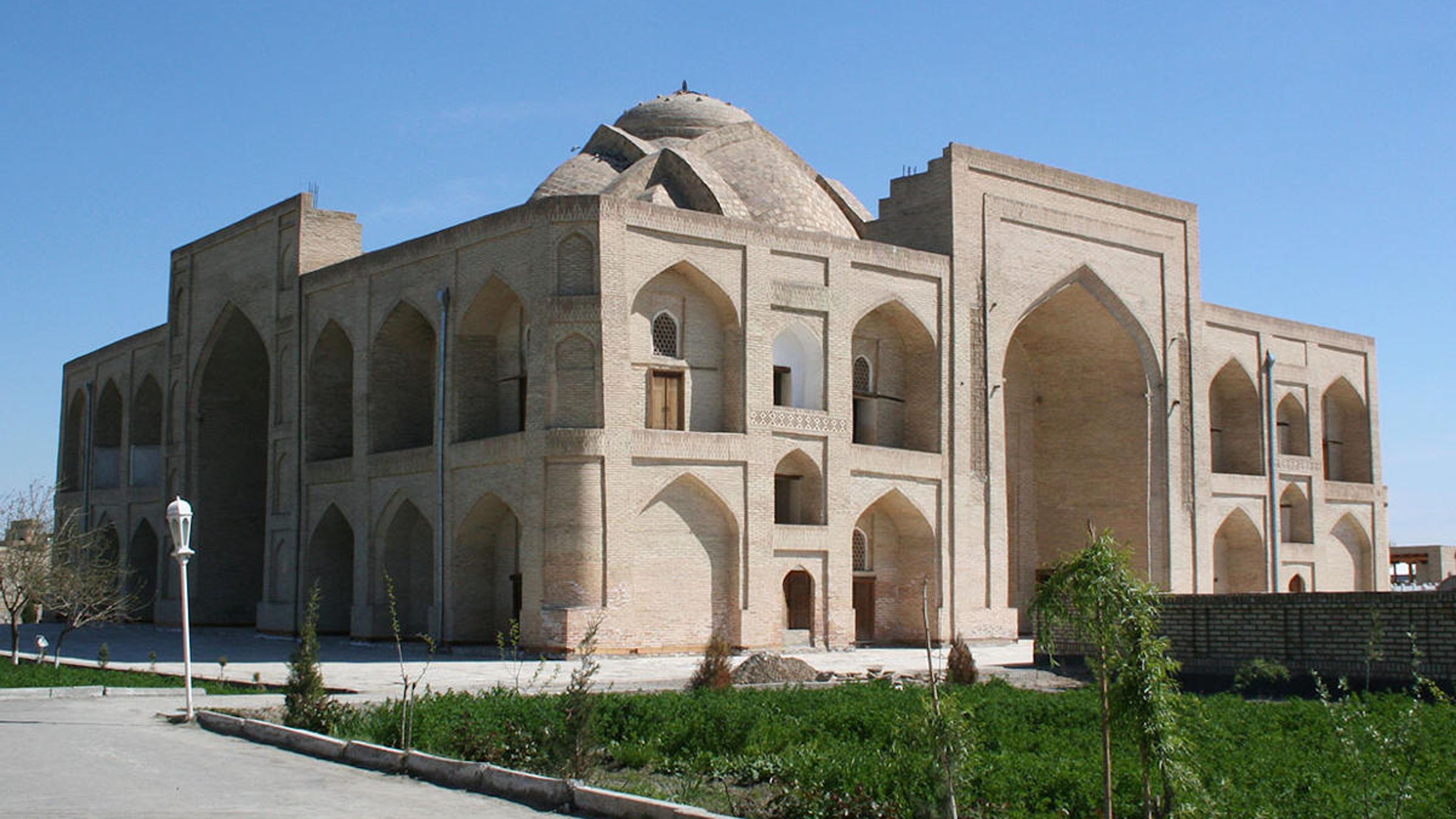
Bukhara - Bahauddin Naqshbandi Complex
The Bahauddin Naqshbandi Complex near Bukhara is a sacred Sufi pilgrimage site and a serene architectural gem, offering deep spiritual insight into Uzbekistan's rich heritage.
About this place
The Bahauddin Naqshbandi complex in Bukhara: a sanctuary of historical significance
The Bahauddin Naqshbandi complex is located on the outskirts of Bukhara, in the village of Kasri-Orifon. This historical monument complex, which was built on the burial site of Saint Bahauddin Naqshbandi, has undergone numerous extensions and alterations over the centuries, as it was considered an honourable duty of the rulers of Bukhara to make their own additions.
The surviving ensemble of Bahauddin's tomb includes a majestic khanaka - a Sufi dwelling built by Khan Abdulaziz in 1545. Another important structure is the large mosque with two aivans, one of which towers over the minaret. This mosque was built in the mid-18th century by order of Khan Abulfeyz's mother.
In the 16th century, the complex took on the form typical of the period, combining a necropolis with a ceremonial building. In 1544, Sheikh Abdulazizkhan I was buried in the form of a floor vault - a dakhma with an ornately carved marble fence on top. Later, the mother of the ruler Abulfeyz-khan (1711-1747) had a mosque with two aivans built with her own funds. In the 19th century, the vizier of Nasrulla-khan, Hakim Kushbegi, had another mosque built within the complex.
A striking landmark of the complex is the minaret, which was built in 1720. During the Soviet era, this sanctuary was in a state of devastation. Another mosque in the inner area of the necropolis courtyard was built almost a century later by Hakim Kushbegi.
The historical significance of the road to Bahauddin Naqshbandi
The construction of the road from Bukhara to the sacred necropolis is associated with significant historical events. The biography of the Bukhara emirs reports: ‘Emir Nasrulla-khan Bokhadur was in the city of Karshi before the death of his father Kushbegi.’
After the death of Emir Haydar in 1826, Prince Hussein ascended the throne of Bukhara, but only ruled from 6 October to 19 December of the same year before he was poisoned by his brother Omar-khan. Omar-khan also only ruled for a short period of four months.
Emir Nasrullah gathered an army and secured the support of Hakim Kushbegi to recapture Bukhara and punish his fratricide. A few days before his accession to the throne, he left his army near Faiziabad and visited the tomb of Saint Bahauddin, where he vowed: ‘When I become emir, I will make a weekly hajj on foot from Bukhara to the tomb of the holy sheikh.’
On 24 April 1827, Nasrullah Khan Bokhadur ascended the throne. True to his promise, he undertook his first pilgrimage to the Mazar of Bahauddin. He also ordered the construction of a paved road from the gates of Bukhara to the holy mazar of Sheikh Bahauddin - a project that was soon realised.
The last Emir of Bukhara, Sayyid Mir Alimkhan, continued the traditions of his predecessors and erected several public buildings near the necropolis, including a large guest house and a bathhouse.
Religious significance and pilgrimages
The Bahauddin Naqshbandi complex in Bukhara developed into an important place of pilgrimage. Two holy wells can be found here, and thousands of pilgrims, tourists and Muslim believers travel to this holy site every year. According to tradition, a three-fold pilgrimage to this sanctuary corresponds to a Hajj to Mecca.
The name of Sheikh Bahauddin Naqshbandi, whose full name is Sayyid Muhammad Bahauddin Naqshbandi ibn Sayyid Jalaliddin, was considered one of the most revered names in the region after that of the Prophet Muhammad. The believers prayed to him with the words ‘Ya Bahauddini bola gardon’ as a protective formula against difficulties. It was believed that this invocation helped to stay protected from impurities, diseases and evil influences.
Whoever asked the saint for intercession supposedly always received his help. This is why the mausoleum of Bahauddin Naqshbandi is one of the most important pilgrimage sites in the Muslim world.
The staff of Naqshbandi - a mystical relic
One of the most fascinating attractions of the complex is the so-called Staff of Naqshbandi. Legend has it that the sheikh once stuck his staff into the ground, whereupon it began to grow and eventually became a tree. Pilgrims place donations in the niches of this tree and pray for blessings. It is said that one should pass under the staff after asking the sheikh for intercession for a good deed.
Restoration and current significance
After Uzbekistan's independence, the complex was extensively restored, particularly in honour of the 675th anniversary of Bahauddin Naqshband's birth in 1993. The darvazakhana (entrance hall) was rebuilt with a high dome, while the magnificently decorated aivans were restored. Today, a spacious garden connects the holy tomb of Hazrat Bahauddin with the tomb of his mother to form a harmonious composition.
The Dakhmai Shohon (necropolis of the rulers) has also been restored, where the remains of several rulers from the Temurid, Shaibanid, Ashtarkhanid and Mangyte dynasties rest.
The Bahauddin Naqshbandi complex remains a place of profound spiritual significance and an architectural jewel that bears witness to the rich history of Bukhara and Central Asia.
💡 Visitor tips
Plan for a 1 to 2-hour visit to explore the quiet courtyards and mausoleum. Respectful dress covering shoulders and knees is required at this holy site. Visit in the early morning for a peaceful experience.
🧳 Travel Essentials
Everything for your perfect Central Asia trip
* Affiliate links – we earn a small commission at no extra cost to you.