
Kyrgyzstan
Kyrgyzstan is the untouched soul of Central Asia. Experience the majestic peaks of the Tien Shan, crystal-clear alpine lakes, and heartfelt nomadic culture up close. A boundless paradise for true adventurers and nature lovers!
📅 Beste Reisezeit
Über Kyrgyzstan
Kyrgyzstan: The Celestial Mountains and the Untouched Soul of Central Asia
Imagine a land where the sky feels so close you could almost touch the stars. A country without fences, only the boundless expanse of green summer pastures where herds of semi-wild horses gallop through knee-high grass. A place where mountain peaks wear brilliant white crowns of snow all year round, and crystal-clear glacial rivers carve their way through deep, fragrant coniferous forests. Welcome to Kyrgyzstan, the hidden jewel of Central Asia.
Often referred to as the "Switzerland of Central Asia," this comparison ultimately falls short. Kyrgyzstan is wilder, more rugged, more pristine, and possesses an archaic beauty that is unparalleled in the modern world. Over 90 percent of the country lies above 1,000 meters (3,280 feet), and the majestic Tien Shan—the "Celestial Mountains"—shapes not only the geography but also the character and deeply rooted nomadic culture of its people. You don't travel to Kyrgyzstan for luxury resorts or all-inclusive vacations. You come here to feel absolute freedom, to experience untouched nature, and to encounter the immense, genuine hospitality of a people who live in rhythm with the seasons. The touristic potential of this country is a dream come true for every adventurer, trekking enthusiast, and cultural explorer.
Bishkek: The Green Gateway to the Tien Shan
For most, the journey begins in the north, in the capital city of Bishkek. Nestled in the Chüy Valley and guarded by the snow-capped four-thousanders of the Kyrgyz Ala-Too range, Bishkek presents itself as one of the greenest metropolises in Asia. Broad boulevards, massive parks, and a grid-like street network bear witness to Soviet urban planning, which has formed a fascinating symbiosis with modern Kyrgyz daily life here.
Bishkek is deeply relaxed and unhurried. A stroll across the central Ala-Too Square, past the monumental statue of the national hero Manas, quickly leads visitors into the heart of urban life. An absolute must-visit is the Osh Bazaar, a labyrinth of colors, smells, and sounds. Mountains of fragrant spices, fresh flatbreads (lepyoshka), nuts, and kurut—salty, dried yogurt balls that are the perfect snack for any mountain hike—are piled high here. Bishkek is the ideal place to acclimatize, drink excellent coffee in hip cafes, and stock up on gear for upcoming expeditions into the high altitudes.
Issyk-Kul: The Warm Pearl of the Silk Road
Heading east from Bishkek, the landscape opens up to reveal a true natural wonder: Lake Issyk-Kul. It is the second-largest alpine lake in the world after Lake Titicaca, sitting at an altitude of 1,600 meters. Its name translates to "Hot Lake," because thanks to a unique microclimate, thermal springs, and slight salinity, this gigantic, deep-blue body of water never freezes, even in the coldest Kyrgyz winters.
The northern shore, particularly around Cholpon-Ata, offers fine sandy beaches and historical treasures like the fascinating open-air museum featuring millennia-old petroglyphs (rock carvings) depicting snow leopards, wolves, and ancient hunters. The southern shore, however, is wilder and more dramatically scenic. Hidden here is the Skazka (Fairy Tale) Canyon, a surreal labyrinth of deep red, orange, and yellow clay and sandstone formations resembling dragon backs or abandoned castles. Also on the southern shore, in the village of Bokonbayevo, locals actively preserve the centuries-old tradition of eagle hunting—a mesmerizing spectacle celebrating the deep bond between the falconer and his majestic golden eagle.
Karakol and the Wild East: The Mecca for Alpinists
At the easternmost tip of Issyk-Kul lies Karakol, the absolute hub for trekking, alpinism, and winter sports in Kyrgyzstan. The town itself exudes the rugged charm of an outpost on the edge of civilization. Here, whitewashed Russian Orthodox wooden churches with green roofs stand alongside the famous Dungan Mosque—a wooden architectural masterpiece built entirely without nails by Chinese Muslims.
Karakol is world-renowned for its Sunday animal market. In the early light of dawn, thousands of sheep, cattle, and horses change hands here. It is a loud, chaotic, and archaic spectacle that catapults you straight into another era. The most spectacular trekking routes in Central Asia start from Karakol. Deep, forested valleys like Jeti-Ögüz (the "Seven Bulls," striking red rock formations) or the Altyn-Arashan valley with its hot, healing thermal springs are absolute highlights. For hardcore alpinists, Karakol also serves as the springboard to the Enilchek Glacier and the gigantic, 7,000-meter-plus peaks of Khan Tengri and Jengish Chokusu (Pik Pobeda) on the Chinese border.
Song-Kul: In the Heart of the Nomad World
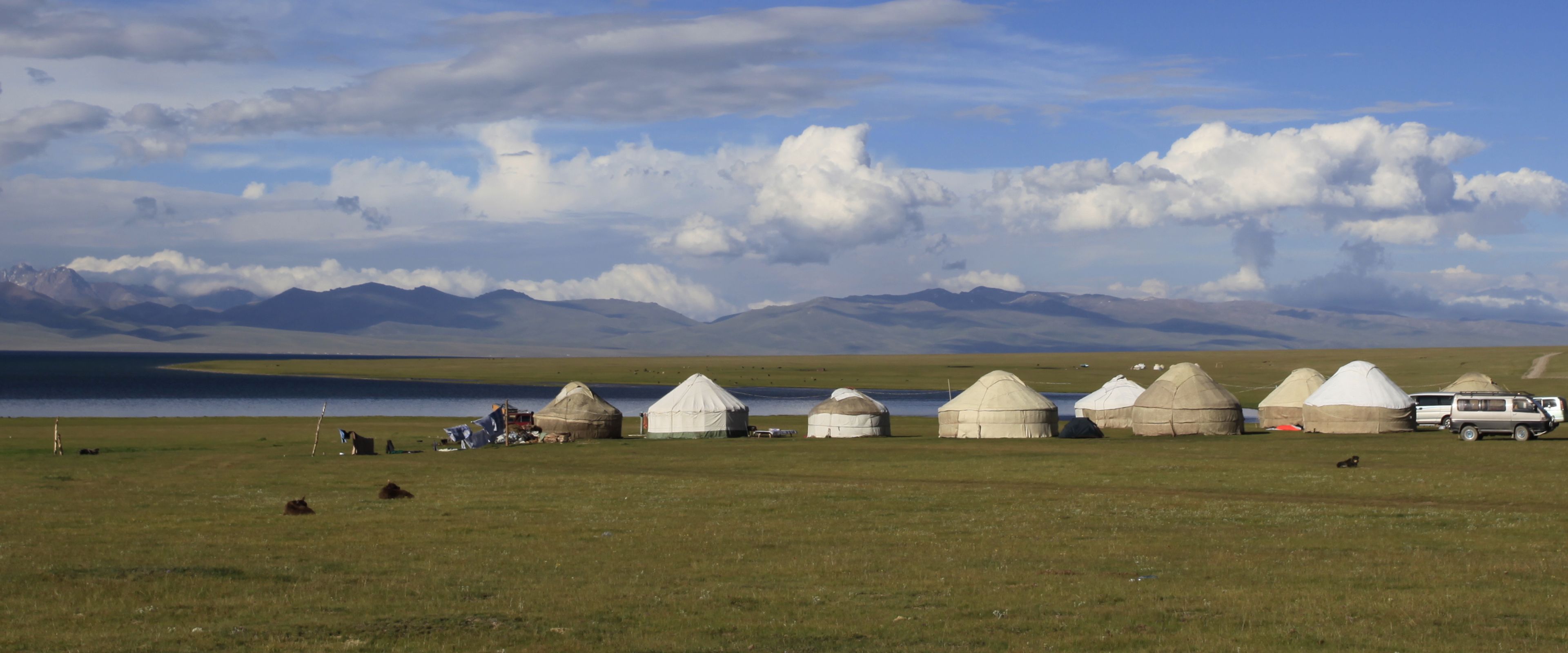
To understand the true soul of Kyrgyzstan, one must visit the jailoo (summer pasture). Song-Kul, a deep blue alpine lake at over 3,016 meters, is the epitome of this nomadic romance. The region is only accessible during the short summer months when shepherds drive their flocks of sheep and herds of horses from the valleys up to the lush green high pastures framed by snow-capped mountains.
There are no hotels, no power lines, and no cell phone reception at Song-Kul. You sleep in traditional yurts, insulated and decorated on the inside with thick, colorful felt carpets (shyrdaks). The absolute silence is broken only by the neighing of horses, the whistling of marmots, and the crackling of the cast-iron stove inside the yurt. The nights here offer a starry sky so clear and bright it seems almost unreal. Those who come here drink fresh kumis (mildly fermented mare's milk), ride sure-footed Kyrgyz horses across endless pastures, and experience an honest, unobtrusive hospitality that touches the soul.
Osh, the Rugged South, and the Pamir Highway
A completely different world opens up in southern Kyrgyzstan. Separated from the north by massive mountain passes, the city of Osh is the cultural and economic center of the south. Located on the edge of the fertile Fergana Valley, Osh is over 3,000 years old, making it older than Rome. The climate here is warmer, the influences of neighboring Uzbekistan are palpable, and life is strongly shaped by the oriental trade of the ancient Silk Road.
The spiritual heart of Osh is Sulaiman-Too (Solomon's Mountain), which rises like a massive rocky spine in the middle of the city. This UNESCO World Heritage site has been a significant place of pilgrimage for millennia. Osh's Jayma Bazaar, one of the largest and oldest markets in Central Asia, stretches for kilometers along the banks of the Ak-Bura River. For adventurers, Osh is also a crucial crossroads: this is where the Kyrgyz side of the legendary Pamir Highway begins, winding its way toward Tajikistan, and it serves as the base camp for expeditions to Peak Lenin (7,134 meters), one of the most accessible 7,000-meter peaks in the world.
Culture and Culinary Delights: A Feast for the Senses
Kyrgyz culture is inextricably linked to nomadic life and the horse. Equestrian games like Kok-Boru—a rough, adrenaline-fueled form of polo that demands profound riding mastery—are the pride of the nation. The cultural heritage is bound together by the Epic of Manas, the longest orally transmitted poem in the world, which sings of the heroic deeds of the warrior Manas and shapes the very identity of the people.
Kyrgyz cuisine is rustic, hearty, and perfectly tailored to the harsh mountain life. Alongside the national dish Beshbarmak (meat and noodles traditionally eaten with the hands), dishes like Manty (steamed dumplings filled with meat and onions), savory clay-oven-baked Samsa, and Lagman—a delicious noodle soup heavily influenced by the Dungan minority—dominate the table. With tea, which is served at all times of the day, you get fresh Boorsok (fried dough cushions), best enjoyed dipped generously into Kaimak (thick, fresh cream).
Why Kyrgyzstan is an Adventurer's Paradise
What makes Kyrgyzstan so incredibly attractive for tourism, besides its epic landscapes, is its unbelievable accessibility. The country is a global pioneer in Community Based Tourism (CBT). This network ensures that tourists stay with local families in homestays and yurt camps. This not only guarantees highly authentic experiences but also ensures that the tourism revenue goes directly to the local population and that nature is protected.
Furthermore, travelers from over 60 countries—including the USA, UK, Australia, the EU, and many others—enjoy visa-free entry for stays of up to 60 days. This makes crossing the border more straightforward than anywhere else in Central Asia. The best time to explore the high mountains and alpine lakes is during the warm summer months from June to September.
Kyrgyzstan is not a country for mass tourism—and that is precisely its greatest blessing. It is a destination for travelers who are ready to leave the asphalt behind to see the world as it was hundreds of years ago. Whoever rides across the steppe on horseback in Kyrgyzstan, feeling the wind of the Tien Shan in their face, will not only find an unbelievable adventure but often also a piece of themselves.
🧳 Reisen nach Kyrgyzstan
Usbekistan in 5 Tagen – zwischen Kuppeln, Karawanen und Kultur
Eine kompakte Zeitreise zu den magischen Oasenstädten der Seidenstraße
Usbekistan in einer Woche – ein Märchen aus 1001 Nacht
Usbekistan klassisch — Perlen der Seidenstraße
Usbekistan Reisen: Kultur, Natur & Seidenstraße
Tauchen Sie ein in den Zauber aus 1001 Nacht, entdecken Sie prachtvolle Oasenstädte und erleben Sie die unberührte Natur Zentralasiens aus der Perspektive lokaler Experten.
Usbekistan und Tadschikistan Reise
Tagestour zu den Sieben Seen von Tadschikistan
📋 Visum & Einreise
Bereit für Ihr Abenteuer in Kyrgyzstan?
Unser Team plant mit Ihnen die perfekte Reise — individuell, fundiert und maßgeschneidert.
Kontakt aufnehmen →